
Blue is the colour – gender and sexuality
I was born at the beginning of the 60s in East London. Mine was not a typical East-End working class family. For a start, my taxi-driver dad was an ex-Communist (having left the British Communist Party, like many in the mid-Fifties when news of Stalin’s atrocities and the invasion of Hungary) and then a Socialist Labour Party Member. Though perhaps we were not that unusual – this was actually much more common and acceptable then than it is now. Only 16 years before I was born, the Soviets had been allies with Britain against the Nazis. Post-war, Socialism and Communism had strong support – there had been several communist MPs elected during the 20th century, the last two up til 1950, with the Labour party winning a landslide victory in postwar elections and implementing radical Socialist policies, like the creation of the NHS and nationalisation of the railways. I took decades of massive media propaganda, Thatcherism and the relentless promotion of a global monoculture of neoliberalism, for the Left to become as almost completely taboo as they are today.
My mum did not have a political background, and though for the first part of my childhood, she was restricted to being a housewife, she had to care for other children to earn some extra income, and in the late Sixties, she started working part-time, looking after disabled children. She must have, by then, been feeling the first doubts about her role in the world that led her into enthusiastically exploring and adopting the feminist ideas that flowered during the seventies.
At any rate, they had some ideas that differed from the norm about bringing up children. I remember when I was very small, having, in addition to my array of teddy bears, a Black boy baby doll. God knows how they managed to get hold of such a thing back then, pre-internet shopping and barely into the civil rights movement here. I am astounded now at how forward-thinking this was for the time. I assume that guided by Marxist and Feminist principles, they wanted me to grow up both with the idea of people of colour normalised from an early age and also without forcing me too much into a rigid gender role. I think most parents at that time (and maybe still now) might have been worried that giving a boy a doll to play with, of whatever colour, would be a bit dodgy, fearing that it ‘might turn me into a “poof” (as this was the risk that was always espoused if boys were exposed in any way to ‘feminine’ things). Somehow, too much association with dolls, which were from that female domain, risked propagating unmanly characteristics in a boy child, as though femininity could ‘contaminate’ by contact. Boys were obviously susceptible to ‘catching’
girlyness and had to be protected and surrounded only by ‘masculine’ things (like guns and tools)… So even then, perhaps there was a subconscious awareness that the genetic pre-determination to masculinity was not quite so inviolable as society made out…
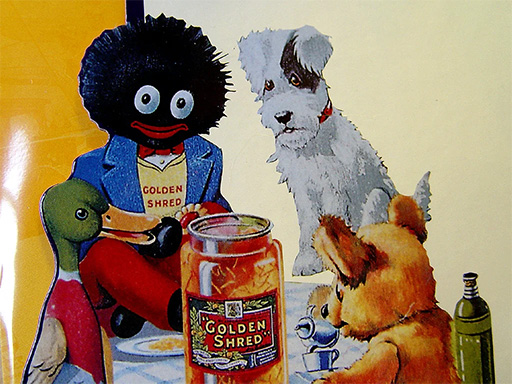
scary racist marmalade
I also remember their dismay sometime in the sixties (probably I was 5 or 6), when I became determined to collect the ‘golliwog’ tokens from Robertson’s marmalade jars in order to get my free ‘gollywog’! (for those of you who are fortunately young enough not to know what this means, these were racist rag dolls in blackface
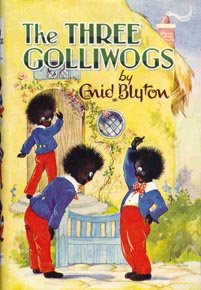
scary racist childrens book
that were rebranded as a ‘golly’ in the Eighties and weren’t eventually retired from the Robertson’s brand until 2002 after becoming highly controversial – Robertson’s products being boycotted by the left-wing, Labour-led GLC (Greater London Council) in 1983). Enid Blighton books (also famous for ‘Gollywog’ characters) were not welcomed in our house for the same reasons (and I didn’t miss them a bit!). This was part of the cultural ‘wallpaper’ that everyone grew up with then – we were surrounded by racist TV like ‘the Black and White Minstrels’ and ‘Love thy Neighbour’… I have a great deal of respect and gratitude for my parents in their effort to resist the tide of cultural brainwashing for us, their children.
 But even in less liberally inclined families back then, things were not so gender determined as they are now. You could buy clothes & toys that (shock horror!) weren’t pink for girls or blue for boys. Green, purple, and red, all were to be found in toy and clothing shops. These were the days before global markets, cheaply mass-produced products and extreme consumerism, and since a lot of baby clothes were knitted and hand-made by relatives or handed down, this flexibility was necessary – poor granny wasn’t such a fast knitter that she could have a suit of baby clothes done in the time that mum was ‘lying-in’ recovering from childbirth! And of course, hi-res ultrasound and gender determination pre-birth was not yet a thing, only becoming common in the early 2000’s, so children were born into homes that weren’t yet gender colour-coded with bedrooms pre-painted blue or pink and gender-specific toys and clothes in place.
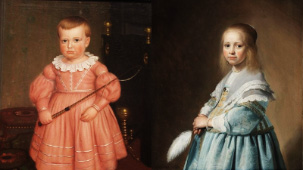
…and They all wore dresses!
It is fascinating to note that in the scheme of things, these now ubiquitous gender markers haven’t always been present; most are relatively recent. In the 19th Century, boy children more often wore pink and girls blue and both wore dresses as infants – though for boys they might be called ‘coats’ they were clearly dresses and were worn until around the age of 6 when they were ‘breeched’ put into breeches), or after towards the end of the 19th C, into short trousers (even when I was growing up, shorts were worn by practically boys – my brother started secondary school in shorts and was ridiculed by the other boys who had all graduated to the full length version).
Not that everything was gender neutral back then. Exposure to male roles leaked in for me as soon as I was able to play with the other boys and then go to school. I remember endless wargames in the street with fingers serving as guns and vocal sounds effects (fed no doubt by the plethora of war comics around then – I was born only 20 years after the end of the 2nd World War). I played with a Meccano construction set (passed down at least a generation and made of steel strips, nuts and bolts – no plastic in sight!) and ‘Matchbox’ toy cars, whilst my younger sister had her tea sets and dollies (some possibly passed down from me!) to dress.
It is hard to imagine what the effects of knowing, as is now commonplace, what the sex of your child will be well before they are born. It may not directly influence the child itself pre-birth, but certainly the parents’ expectations and attitudes are pre-developed in the months before the child is born – the gender straight-jacket is already firmly in place, ready to receive the newborn baby as soon as it enters the world.
The influence of Media from childhood
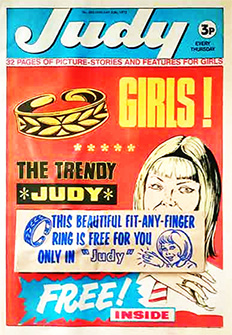
Girls must be girls
Comics were the anticipated weekly treat – Every week I would read The Beano (and The Dandy if I could get it – my family’s budget didn’t stretch to 2 weekly comics). In these were stories mainly featuring boys and aimed at them – school stories full of old-fashioned naughty schoolboys tricking their ‘schoolmasters’, football heroes and the odd war tale, and they excitingly often contained free ‘gifts’, like the ‘Thunderbang’ – a noise maker made of cardboard. As I got older, football magazines, like Shoot! took their place.
The narrative was different for girls. As an avid reader, I hoovered up anything that came into the house, so when my sister started getting comics like Bunty and Judy, I would happily read them too, soaking up endless tales about girls who wanted to be ballet dancers or ride ponies but whose horrible stepmother would only pay for her own daughter’s lessons and whose step-sisters were mean to them…
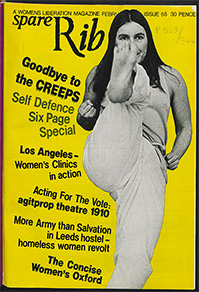
Women Power! Cover of Spare Rib Magazine
I graduated to a radically different perspective on female experience from age 11, when my mum started getting Spare Rib – a feminist magazine that started in 1972 – which I also read every month from cover to cover. This went hand-in-hand with my mum increasingly removing herself from typical house-wife roles – she started to insist that if I wanted anything ironed, I would have to do it myself (that and having to wear a school uniform led to my early and lifelong adoption of casual dress!) and her reluctance to spend all day cooking, meant that I learned that skill and avoided the trap that so many men of my age later found themselves in, of being reliant on a woman for nurture. I see so many old guys now who, if they (uncommonly) outlive their wives, start to smell and exist only on baked beans and ready-meals.
Although at the time, being used to having my needs met, I resented this withdrawal of services, I have been forever grateful to my mum for equipping me with these valuable survival skills. I love cooking to this day.
Two types of Human? Sex vs Gender & the artificial binary nature of humans
In some ways, growing up in this radical family home, with role models who were non-typical for the time, my upbringing was not that of a typical child of the time and surroundings.
Also, from an early age, my closest friend was a girl. She was my mum’s best friend’s daughter, and we were inseparable from as early as I can remember. Since we were with each other all the time from before we could speak, I felt as though we could read each other’s minds, and our closeness was at a deep level. After that, I continued to spend a lot of time playing with girls – not falling into the trap of gender-ghettoisation(?) that I realise now happens from quite an early age – the other boys seemed only interested in playing with each other – mostly war games, which I found fun but perhaps restricted in terms of the opportunity to practice socialisation and relationship!
I learned early from these relationships that boys and girls were similar – that we were made of the same stuff – more alike than different. I never felt in any way fundamentally different from the girls around me, and for that reason, as an adult, I never fell for the men are from Mars, women are from Venus fallacy. It’s obvious (to me anyway) that the seemingly inseparable differences between the sexes are largely due to differing life experience and early conditioning and not to any biologically determined difference of nature. We are (or can be) united in our shared Humanity.